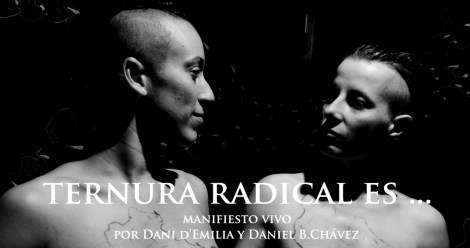
The Radical Tenderness Manifesto is an embodied poetic exercise of resistance where we dive into this seemingly oxy-moronic term asking ourselves: ‘how can radical be tender – and tenderness be radical – in our alliances, our communities, and our interpersonal relationships?’
ESPAÑOL (pdf), original version published by Hysteria Magazine (online, Jul 2015)
PORTUGUÊS (pdf), transl. by Dani & Daniel (gravação na voz de Miro Spinelli aqui)
ENGLISH (pdf), transl. by Dani & Daniel
ITALIAN (pdf) (transl. by Francesca Carol Rolla and Irene Pomatto)
FRENCH (pdf) (transl. by Quimera Rosa)
CATALÁN (pdf) (transl. by Ariadna Pous Solà)
GERMAN (pdf) (transl. by Caro Ley)
TURKISH (pdf) (transl. by Leman Sevda Darıcıoğlu / Fuck me Kitty)
__
Dani d’Emilia and Daniel B. Coleman (previously Daniel B. Chavez) are performance artists, transfeminist activists and educators. They met in 2011 and collaborated on several transcontinental performance and pedagogical projects as core members of La Pocha Nostra until 2016 (Dani from 2011, daniel from 2014) and Proyecto Inmiscuir between 2015-17.
The first version of this Radical Tenderness Manifesto was initiated through an online poetic jam between Dani and Daniel in 2014, as part of Dani’s research on radical tenderness within the context of her MA at PEI (independent studies program directed by Paul Preciado at in MACBA, Barcelona). It was presented as part of Dani’s thesis and published online by Hysteria Revista (MX) in 2015. The manifesto has since been kept alive through various independent translations, publications and performative activations.
__
Radical tenderness is a term that I first encountered while working as part of the performance collective La Pocha Nostra (2009-2016), where it was used in the context of the radical performance-pedagogy workshops we facilitated. The term resonated with me very intimately as I recognized in it a force that I had always felt but had not previously found language to name. I also felt how it resonated with many others within and beyond the collective, calling us into another form of engagement with political practices that involved hightening our sense of care for the many bodies we inhabit and are in relationship with.
Radical Tenderness is an entity-force that moves, transforms and disseminates itself in many different ways. Throughout the years I have understood the political roots of the term radical tenderness to be in the transfeminist community of Mexico, so it is crucial that in its genealogy as a term and its activation as an embodied practice, we recognise and honour the importance of the transfeminist movement, and in particular also the work of the mexican trans activist and educator Lia La Novia Sirena.
I have personally been in a profoundly transformative dance with Radical Tenderness for over a decade, attempting to listen to and integrate its teachings in my performance-pedagogy work, my artistic creations and my every day life. This process involves an embodied investigation of its intimate, political, and metabolic movements, which has included creating performances, workshops and writings that attempt to nurture radically tender ways of being.
Please refer to the different sections of my website for more info on some of these artistic and pedagogical (un/re)learnings. You may also be interested in accessing directly the following links:
- Co-sensing with Radical Tenderness (text, 2020)
- Art-Life Ritual Actions for Radical Tenderness (performance series, 2020)
- Radical Tenderness Workshops (2011 – present)
___
 Dani d'Emilia
Pingback: TERNURA RADICAL / RADICAL TENDERNESS (POST) | Dani d'Emilia·
Pingback: Ni cursi ni endeble: la “ternura radical” se reivindica en la cultura como antídoto a las violencias – mundoactualidad·
Pingback: Ni cursi ni endeble: la “ternura radical” se reivindica en la cultura como antídoto a las violencias – letrasgalardonadas·
Pingback: Ni cursi ni endeble: la “ternura radical” se reivindica en la cultura como antídoto a las violencias – letrasdeoro.es·
Pingback: Ni cursi ni endeble: la “ternura radical” se reivindica en la cultura como antídoto a las violencias – perspectivaliteraria·
Pingback: Ni cursi ni endeble: la “ternura radical” se reivindica en la cultura como antídoto a las violencias – radarcultural·